Fieldscope Builder
A CRM built to replace paper quotes — and the one everyone said couldn't be built simple.
- Role
- UX Designer & Builder
- Client
- Industrial fabrication company
- Timeline
- 3 months
- Impact
- 0 — Paper quotes left in the process
The Problem
Quotes handled entirely through Word docs and business cards, with zero pipeline visibility.
What I Built
A custom CRM around a no-dead-end data principle, after Salesforce and QuickBooks were both rejected.
The Result
Used daily; scaled into a full sales, reporting, and logistics platform.
Overview
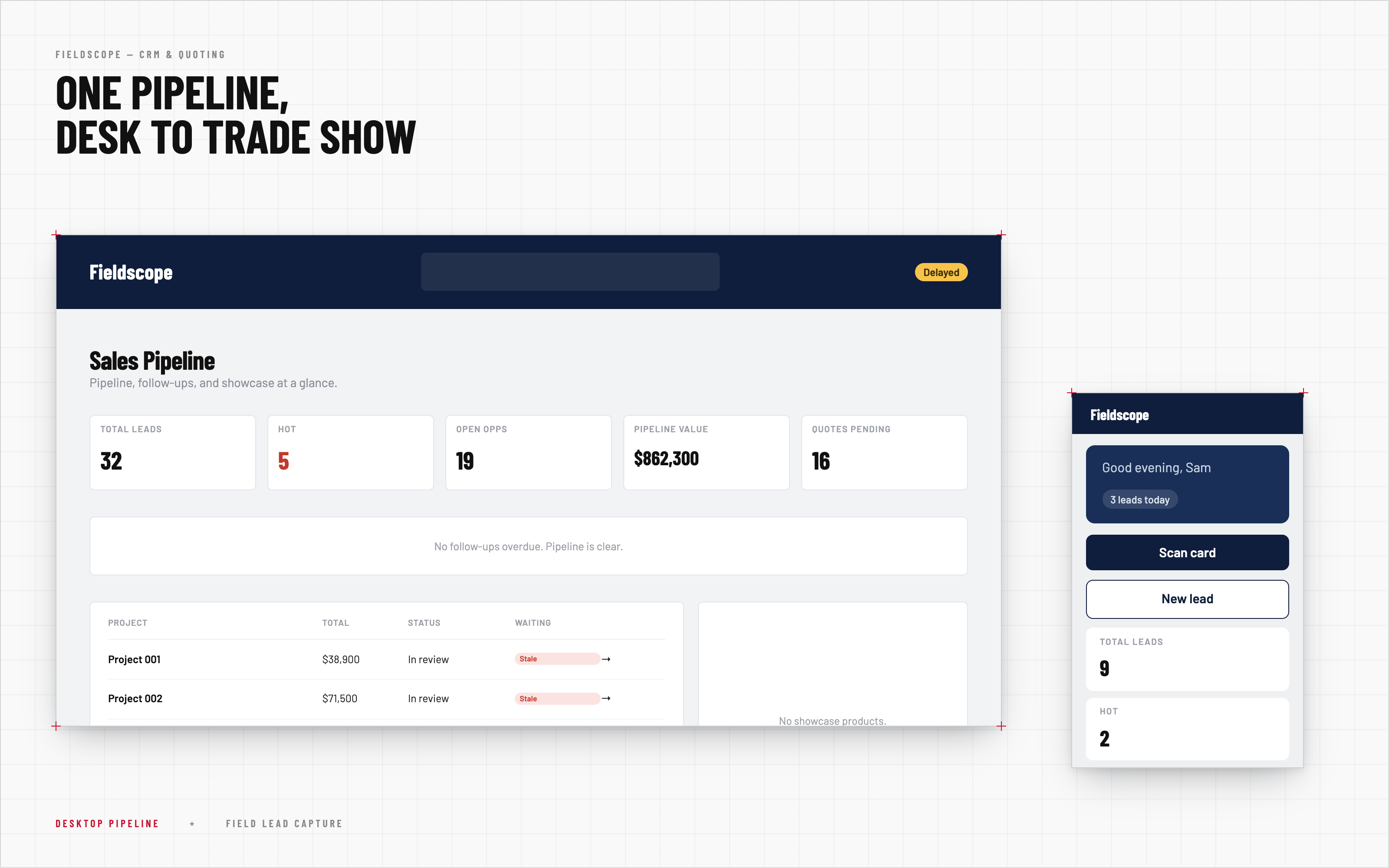
A custom CRM and quoting system built for an industrial manufacturing company's sales director, replacing paper quotes, spreadsheets, and email — the first step in a broader shift away from off-the-shelf tools that didn't fit how the team actually worked.
Problem
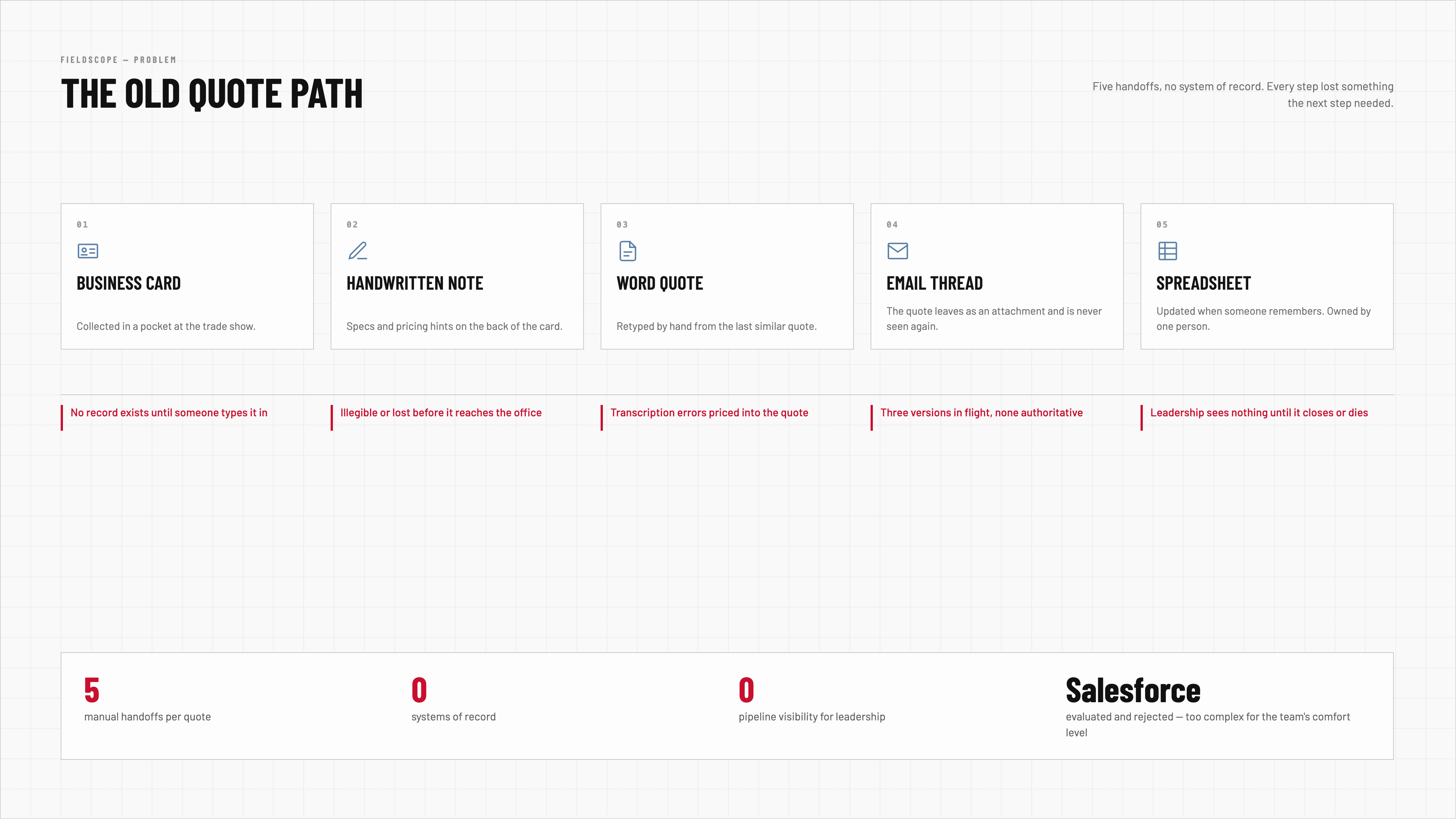
Quote turnaround was slow and error-prone, running entirely through Word documents. Leadership had no visibility into the sales pipeline. Leads existed as physical business cards and handwritten notes, with no system to track or convert them.
Process
Discovery
Ran structured interviews with the sales director and production manager — covering pipeline stages, quoting workflow, and the sales-to-production handoff — using "in a perfect world, my workflow would look like this" prompts to map the ideal process rather than starting from a generic CRM template.
The First Proposal
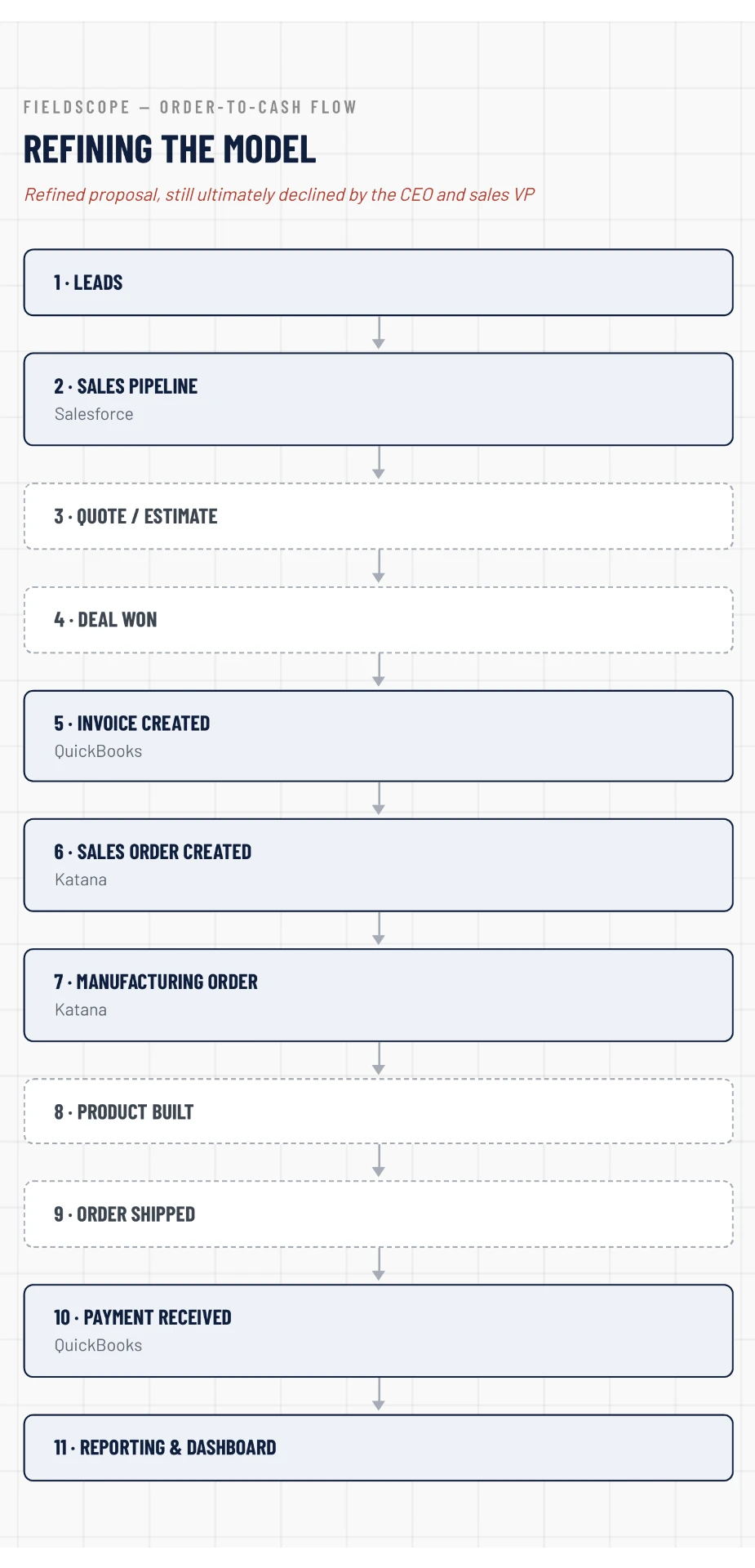
Initial discovery pointed toward a textbook three-system split: Salesforce for sales, Katana for production and inventory, QuickBooks for accounting — each department owning its own system of record.

The Pivot
Refining the Model
The architecture was worked into a more granular version, breaking the deal lifecycle into explicit stages — quote, invoice, sales order, manufacturing order, shipment, payment — each tagged to the system responsible for it.
The Veto
The CEO rejected QuickBooks — wary of future integration changes and upcharges — while the sales director rejected Salesforce as too complex for the team's technical comfort level. Two different stakeholders, two different objections, sending the project in a different direction than the original recommendation.
Solution
Data Architecture
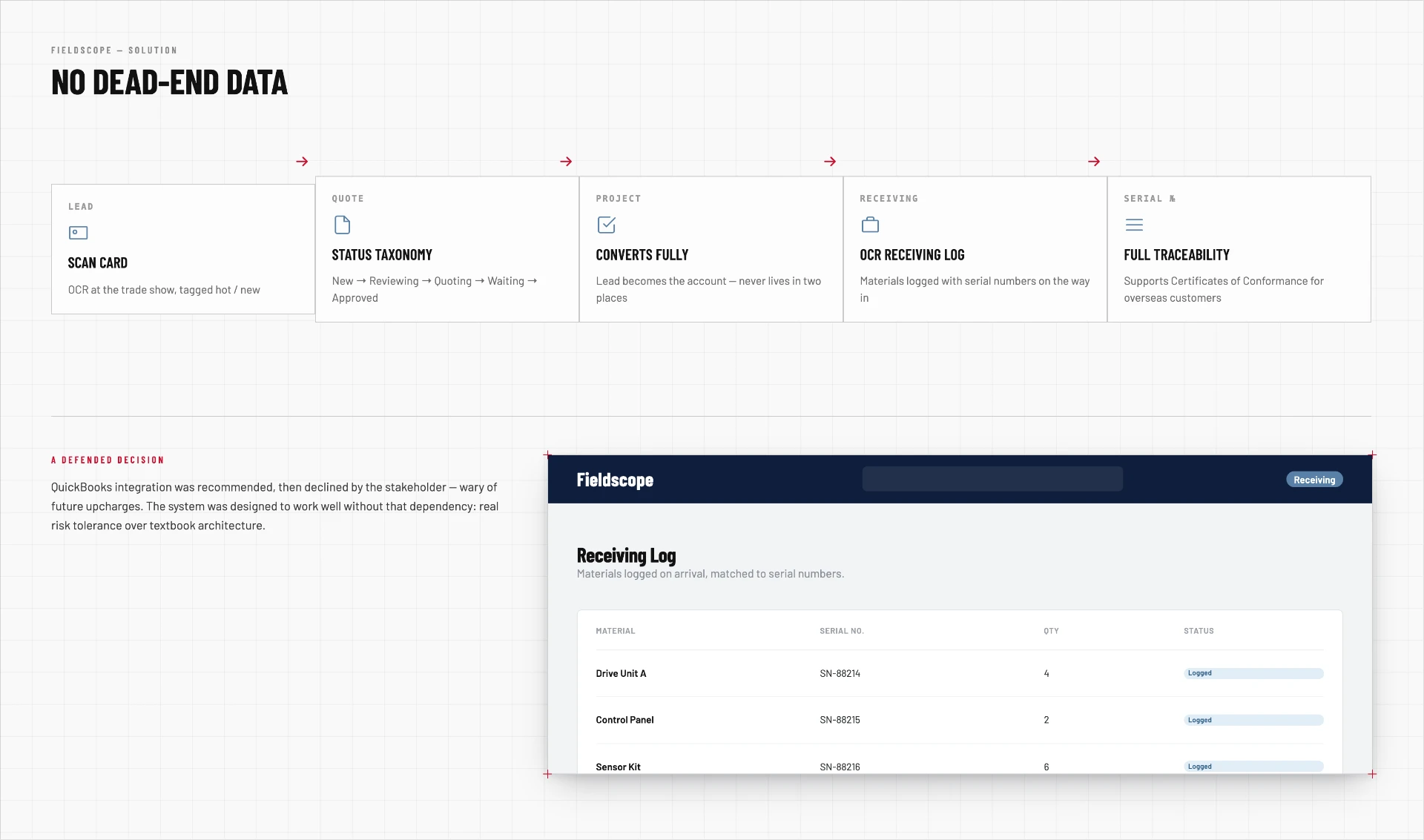
The system was built around one core principle: no dead-end data. When a lead converts, it fully transitions into an account/contact rather than living in two places at once — nothing gets lost or duplicated across disconnected lists. The status taxonomy (New, Reviewing, Quoting, Waiting, Approved) mirrors the business's own internal language rather than imposing generic CRM jargon on the team.
Trade Card Capture
A trade card scanning module (OCR/QR) was added after the sales director described stacks of business cards piling up on his desk with no system to process them. It let him capture leads live at trade shows, feeding directly into the leads module with status tags (hot, new this week, open opportunity) and conversion tracking — no manual re-entry required.
Logistics Expansion
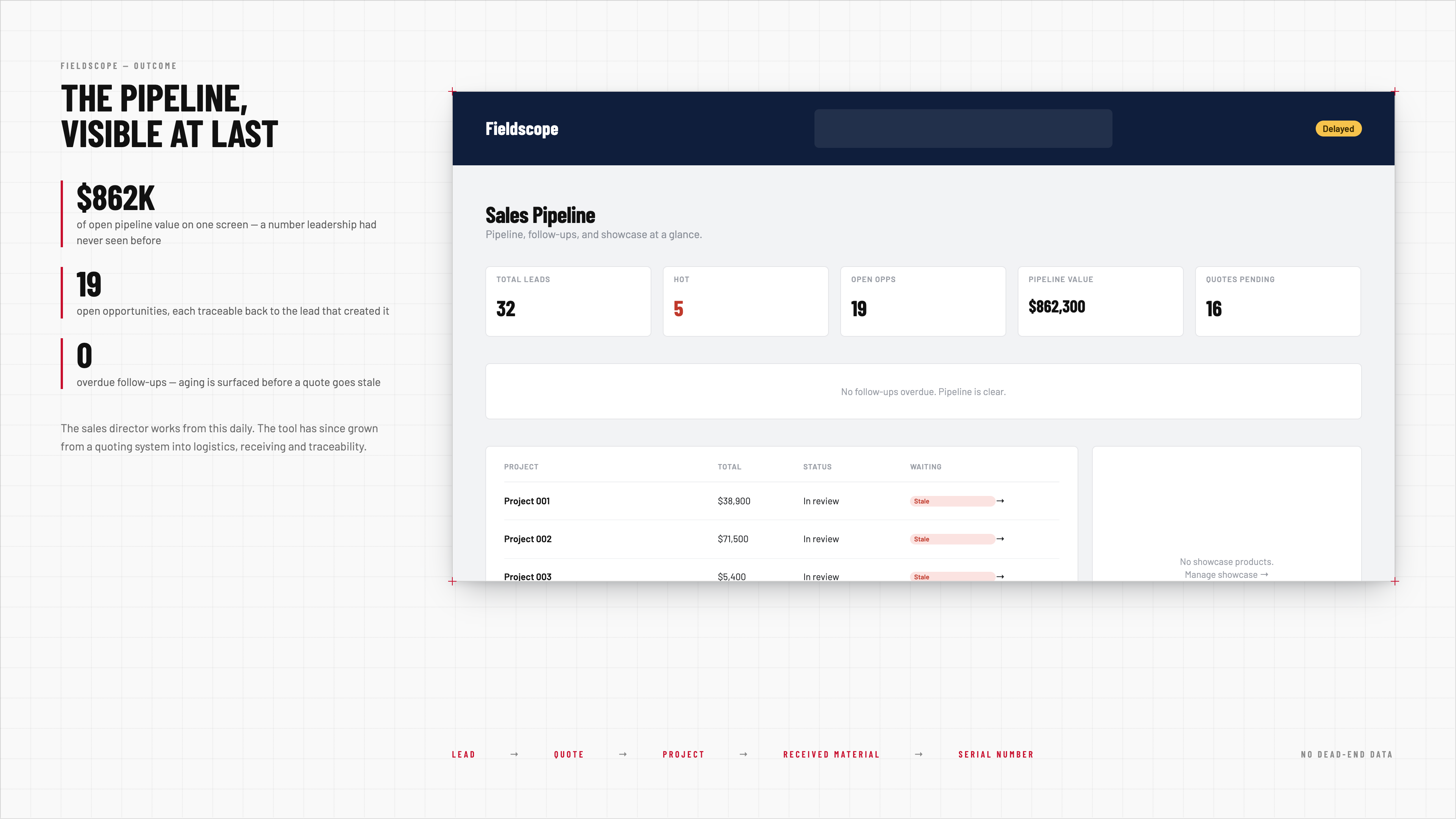
The system later expanded into a logistics module, driven by the sales director's own need: he was acting as interim logistics lead and needed mobile-friendly access to shipping addresses on the go. This grew into an OCR-based receiving log that captures materials with serial numbers for full traceability — critical for producing Certificates of Conformance when manufacturing for overseas customers. That module is currently in testing, and extends the same no-dead-ends principle end to end: lead → quote → project → received material → serial number, fully traceable in one direction.
Outcome
The sales director actively uses the system daily and can now see his full pipeline visually for the first time. The tool has scaled from a quoting system into a broader operations platform covering sales, executive reporting, and logistics — all on data the whole team trusts, which matters for a user base in their 50s and 60s who need one clear path through their work, not five different places to check.
The Katana manufacturing integration from that original proposal wasn't dropped — it's an active thread, currently on hold pending funding.
Next project
Fieldscope Time Tracker
1Security exploit caught in week one
Read case study